

I may have been born in the U.S., but my parents made sure I learned their native language, Brazilian Portuguese, before I ever set foot in an American classroom. My mom went so far as to bring VHS tapes of Portuguese-dubbed Disney movies from Brazil, ensuring my first contact with “Cinderella” was in her native tongue.
I picked up English later, in preschool, from the other kids. But I’ve always appreciated the effort my parents made to instill the language in me — including sending me to the south of Brazil every summer to spend time with both my grandmothers. That’s where I picked up the distinct gaúcha accent; the kind where we roll our “r’s” and say “tu” instead of “você” for “you.” It’s a regional way of speaking that instantly signals where you’re from.
Yet after moving to Rio de Janeiro five years ago, I’ve also become fluent in “carioquês” — the accent and slangy expressions unique to the city. Don’t worry, we’ll get more into that below. Considering Brazil is one of the top travel destinations for 2026, I’ve rounded up the essential Portuguese phrases for travel that you should know, whether you’re heading to Rio’s beaches, Bahia’s coast, or beyond.

Greetings & Polite Basics
In Brazil, a greeting goes beyond just “hi” or “hello.” “Oi, tudo bem?” is the most common way to start a conversation, whether you’re meeting someone in person, calling them, or even sending a text. It’s considered more polite to ask how someone is rather than jumping straight into a question.
You’ll also notice that Brazilians greet everyone as soon as they walk into an elevator, a small shop, a beach kiosk, or even a doctor’s office. It’s customary to say “Bom dia,” “Boa tarde,” or “Boa noite” to everyone there, depending on the time of day.
- Hi — Oi
- Hello — Olá
- Good morning — Bom dia (used as a greeting before noon)
- Good afternoon — Boa tarde (used as a greeting from noon until about 6 p.m.)
- Good evening / Good night — Boa noite (used as a greeting after 6 p.m.)
- Welcome — Bem-vindo (male) / Bem-vinda (female)
- Nice to meet you — Prazer (short for “Prazer em conhecer você”)
- How are you? — Tudo bem?
- Everything is great — Tudo ótimo (the typical response to the question above)
- Please — Por favor
- Thank you — Obrigada (if you’re female) / Obrigado (if you’re male)
- Thank you so much — Muito obrigada (female) / Muito obrigado (male)
- You’re welcome — De nada
- Excuse me — Com licença
- Sorry — Desculpa
- See you later — Até mais
- See you soon — Até logo
- See you tomorrow — Até amanhã
- Have a good day — Tenha um bom dia
- Have a good afternoon — Tenha uma boa tarde
- Have a good night — Tenha uma boa noite
- What’s your name? — Qual é o seu nome?
- My name is… — Meu nome é…
- Bless you — Saúde (used when someone sneezes)
Ordering Food & Coffee
Now let’s move on to one of the most important categories: food and coffee.
- Restaurant — Restaurante
- Food — Comida
- Drink — Bebida
- Menu — Cardápio
- Breakfast — Café da manhã
- Lunch — Almoço
- Dinner — Jantar
- Coffee — Café
- Coffee with milk — Café com leite
- Espresso — Café expresso (often just “expresso”)
- Iced coffee — Café gelado
- I’d like a coffee, please — Um café, por favor
- No ice — Sem gelo
- Without sugar — Sem açúcar
- Water — Água
- Still water — Água sem gás
- Sparkling water — Água com gás
- Filtered tap water — Água da casa (Restaurants in Rio de Janeiro are required to provide filtered tap water free of charge to customers)
- Wine — Vinho
- Red wine — Vinho tinto
- White wine — Vinho branco
- Beer — Cerveja
- Draft beer — Chopp (very common in Rio de Janeiro)
- Another round — Mais uma
- Juice — Suco
- Freshly squeezed juice — Suco natural
- The bill, please — A conta, por favor
Getting Around (Trains, Uber, Directions)
Getting around Brazil is fairly straightforward in major cities, especially with ride-share apps like Uber widely available. Still, knowing a few transportation and direction-related words makes navigating airports and public transportation much easier.
- Hotel — Hotel
- Airport — Aeroporto
- Taxi — Táxi
- Uber — Uber
- Train — Trem
- Train station — Estação de trem
- Metro — Metro
- Bus — Ônibus
- Bus station — Rodoviária
- Car — Carro
- Ticket — Bilhete or Passagem
- Street — Rua
- Avenue — Avenida
- Bank — Banco
- ATM — Caixa eletrônico
- Beach — Praia
- City — Cidade
- Store — Loja
- Left — Esquerda
- Right — Direita
- Where is the station? — Onde fica a estação?
- Where is the beach? — Onde fica a praia?
- How much does this cost? — Quanto custa isto?
- Can you take me to…? — Pode me levar para…?
Hotel & Airbnb Phrases
Next up: the Portuguese phrases for travel check-ins and check-outs.
- Reservation — Reserva
- I have a reservation — Tenho uma reserva
- In the name of… — No nome de…
- Check-in — Check-in
- Check-out — Check-out
- What time is check-out? — Que horas é o check-out?
- Room — Quarto
- Key — Chave
- Key card — Cartão-chave
- Wi-Fi password — Senha do Wi-Fi
- Air conditioning — Ar-condicionado
- The air conditioning isn’t working — O ar-condicionado não está funcionando
- Hot water — Água quente
- There’s no hot water — Não tem água quente
- Towels — Toalhas
- Sheets — Lençóis
- Blanket — Cobertor
- Can you help me? — Pode me ajudar?
- Can I have…? — Posso pedir…?
- Is breakfast included? — O café da manhã está incluído?
- Where is the elevator? — Onde fica o elevador?
Emergencies & Health
These are the essential Portuguese phrases for travel mishaps, which, hopefully, you won’t need to use at all.
- Help! — Socorro!
- I need help. — Preciso de ajuda.
- Call the police. — Chame a polícia.
- Call an ambulance. — Chame uma ambulância.
- Where is the hospital? — Onde fica o hospital?
- Where is the pharmacy? — Onde fica a farmácia?
- Police — Polícia
- Hospital — Hospital
- Pharmacy — Farmácia
- Doctor — Médico
- Nurse — Enfermeiro
- I don’t feel well. — Não estou me sentindo bem.
- I feel sick. — Estou passando mal.
- I have a headache. — Estou com dor de cabeça.
- I have a stomachache. — Estou com dor de estômago.
- I’m allergic to… — Sou alérgica (female) / alérgico (male) a…
- I need medicine. — Preciso de remédio.
- Is there a clinic nearby? — Tem uma clínica por perto?
- Emergency number (police) — 190
- Emergency number (ambulance) — 192
- Emergency number (fire department) — 193

Rio de Janeiro Slang
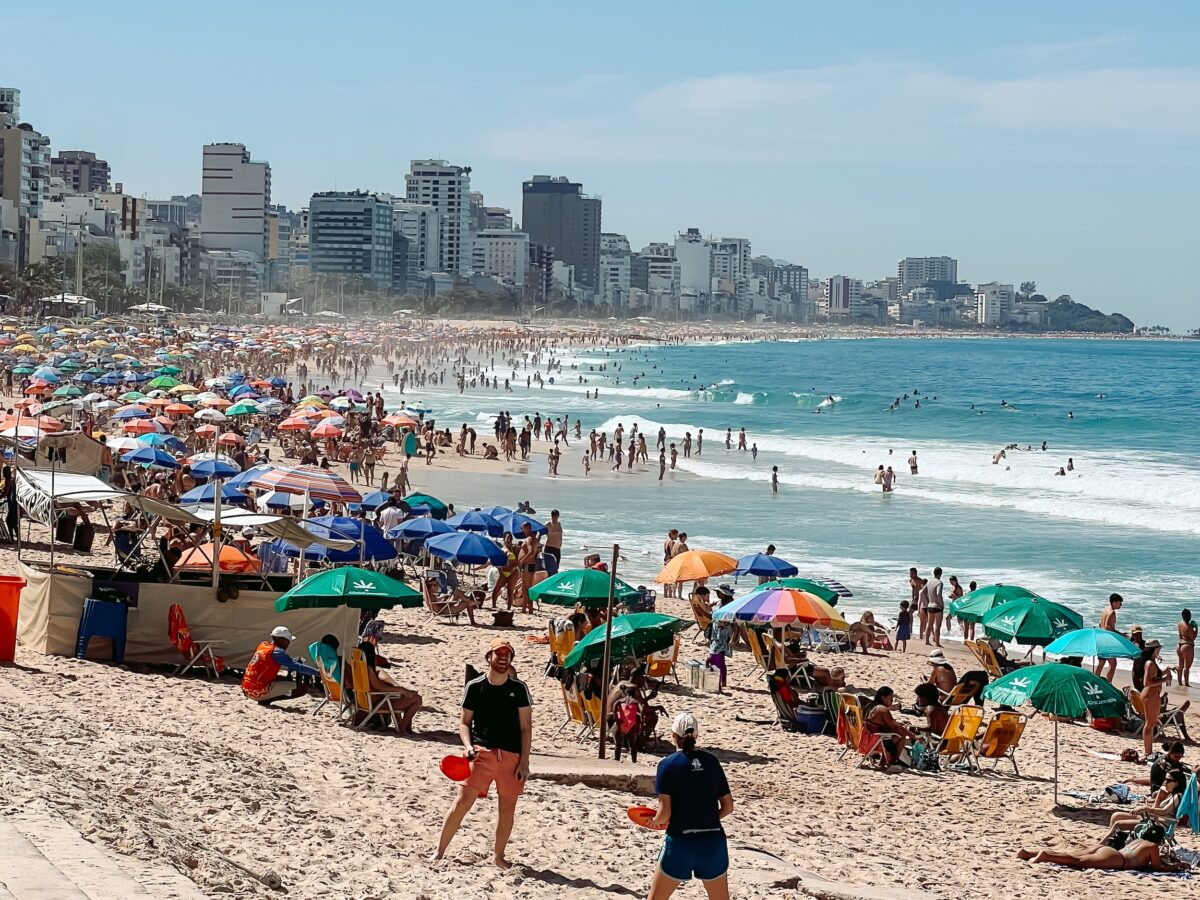
Locals from Rio are called cariocas. But the word carries more meaning than its simple definition. Across Brazil, cariocas are known for their distinctly laidback, beach-loving lifestyle. They’re street-smart, extremely social, and deeply connected to the city’s outdoor culture.
Cariocas also speak with what’s known as a “chiado” — a soft “sh” sound that replaces certain “s” sounds, especially at the end of words. For example, “mesmo” (same) can sound like “mezh-mo,” and “dois” (two) can sound closer to “doish.” It’s subtle but unmistakable, and once you hear it, you’ll start noticing it everywhere.
Here are a few of the most common slang terms you’ll hear while visiting Rio.
- What’s up? — E aí? (extremely common, very informal)
- All good? — Tudo certo? (a variation of “Tudo bem?”)
- Dude / Bro — Cara (Used constantly, for men and women.)
- Chill / Relax / It’s all good — Tranquilo
- Let’s go — Bora (short for “vamos embora” and commonly said before heading out)
- Let’s do it / I’m in / Game on — Partiu
- Partiu praia? — Beach? Let’s go?
- Partiu jantar. — Let’s go to dinner.
- Partiu! — I’m in. / Let’s do it.
- We’re in this together / I’ve got your back — Tamo junto (a very carioca expression of solidarity or support)
- Wow / No way — Caraca (a mild expression of surprise)
- That’s tough / What a mess — Que perrengue (used when something goes wrong, like getting caught in sudden rain)
- Crazy / Wild / Intense — Sinistro (depending on tone and context, it can mean “awesome” or “sketchy”)
European Portuguese vs Brazilian Portuguese
Many travelers are surprised by how different European Portuguese is from the Portuguese spoken in Brazil. I, for one, have a hard time understanding European Portuguese as a native Brazilian Portuguese speaker.
Brazilian Portuguese tends to sound more open and melodic, with longer vowel sounds and clearer pronunciation. European Portuguese, on the other hand, often sounds faster and more compressed, with softer or dropped vowels.
Overall, however, if you learn the basics, you’ll be understood in Brazil. The key difference is mostly in the rhythm and pronunciation. There are some vocabulary differences; let’s go over those below.
Common Word Differences to Know Before You Go
Even if the languages are closely related, you’ll quickly notice that some everyday words are completely different.
- Bus — Autocarro (Portugal) vs. Ônibus (Brazil)
- Bathroom — Casa de banho vs. Banheiro
- Goodbye — Adeus vs. Tchau
- Breakfast — Pequeno-almoço vs. Café da manhã
- Train — Comboio vs. Trem
- Cell phone — Telemóvel vs. Celular
- Juice — Sumo vs. Suco
- Ice cream — Gelado vs. Sorvete
- Refrigerator — Frigorífico vs. Geladeira
- ATM — Multibanco vs. Caixa eletrônico
- To take a shower — Tomar duche vs. Tomar banho
- To catch/grab — Apanhar vs. Pegar