


At a Glance
| Beach type | Long stretch of sandy urban beach |
| Access | Easy; direct access from the street, with several nearby metro stations and bus routes |
| Entry permit | None |
| Crowds | High, especially on sunny weekends, holidays, and during Brazilian summer |
| Best for | Everyone. Swimming, sunbathing, people-watching, beach sports, and experiencing Rio’s beach culture |
| Facilities | Restrooms, changing facilities, beach kiosks, chair and umbrella rentals, bike path, and nearby restaurants and shops |
| Lifeguard | Yes |
| Dogs allowed | Yes |

Why is Copacabana Beach so famous?
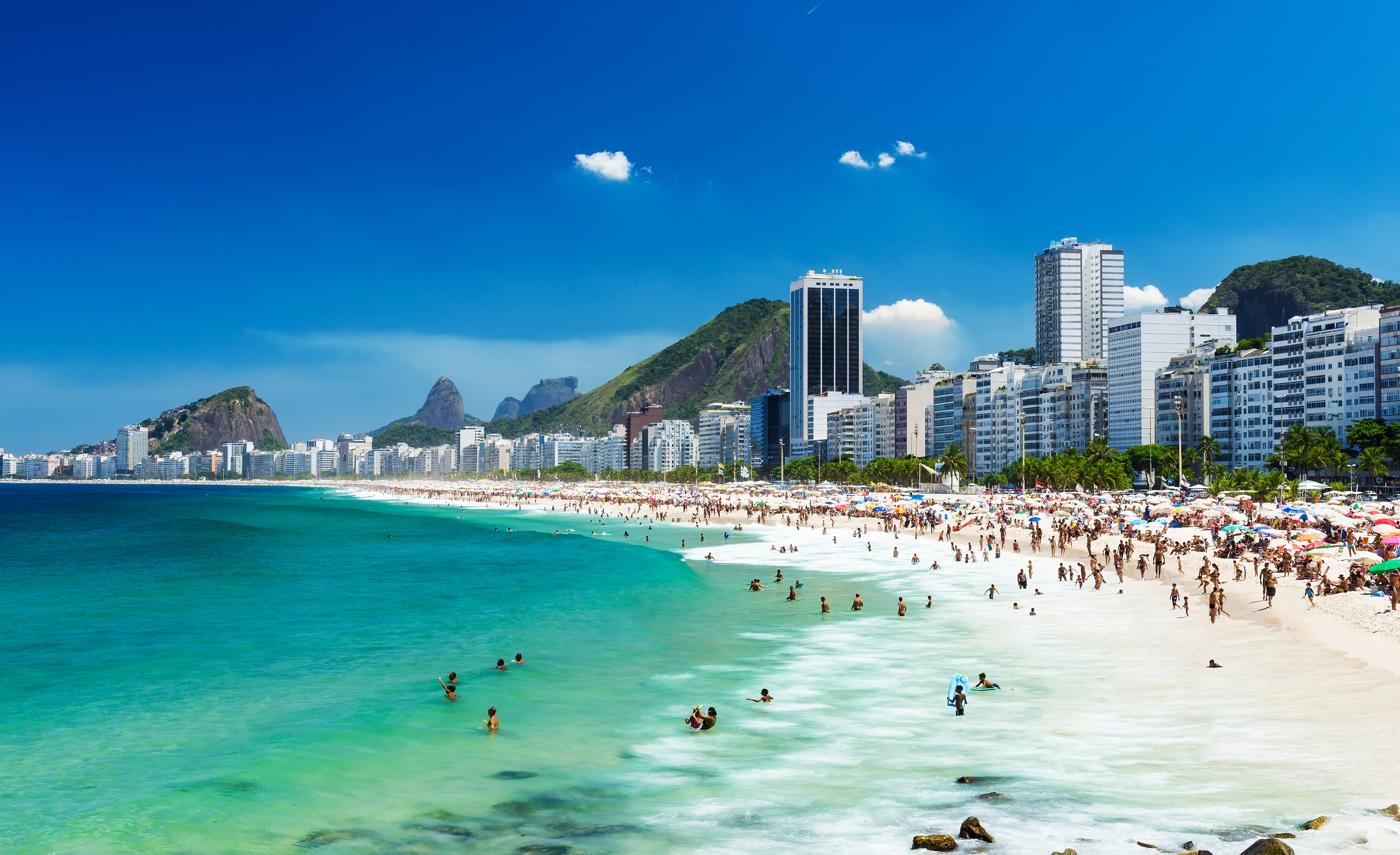
Copacabana Beach is one of the most recognizable beaches in the world. Stretching roughly 2.5 miles along Rio de Janeiro’s tourist-friendly South Zone, the beach has long functioned as a giant outdoor living room for Rio de Janeiro—a place for swimming and sunbathing, but also soccer games, samba, protests, celebrations, spontaneous midday meetups, and some of the largest spectacles on the planet.
The 1923 opening of the glamorous Copacabana Palace helped establish the beachfront as an international destination, drawing celebrities, politicians, and other high-profile guests to what was then an emerging seaside neighborhood. The beach’s black-and-white wave-patterned promenade is another undeniable Rio icon. And then there’s the scenery: a wide-open horizon, near-perfect curling waves, and mountains rising in the distance.
On especially clear days, I’ve even spotted sea turtles while swimming.
Copacabana’s fame also stems from the many events that take place on its sands. Every December 31, millions of people, most dressed almost entirely in white, pack the sand for Rio’s famous New Year’s Eve celebration, with live music and fireworks launched from barges offshore.
More recently, Copacabana has also become the stage for a new series of enormous free concerts. Madonna, Lady Gaga, and Shakira have all thrown shows here, with Gaga’s performance becoming the biggest concert of her career.
That combination of history, scenery, and sheer spectacle is what makes Copacabana more than simply a beautiful beach. And for me, it’s also the place where I lived alone for the first time. My very first apartment sat just off Avenida Atlântica, the wide avenue that traces the length of the beach. My two windows gave me sweeping views of the bluest ocean, where for one year, I fell asleep to the sound of Copa’s waves hitting the shore.

How to Get to Copacabana Beach
Copacabana sits between Leme and Ipanema beaches, and is one of the easiest in the city to reach without a car.
By metro: Three stations serve the neighborhood: Cardeal Arcoverde, Siqueira Campos, and Cantagalo. From any of them, it’s roughly a 5- to 15-minute walk to the sand.
By Uber or taxi: Uber and taxis are widely available throughout Rio. Use one of the numbered postos, or lifeguard stations, as your destination to help pinpoint the right section of the beach you’re going to.
From Ipanema: If you’re staying in Ipanema, Copacabana is close enough to reach on foot from the eastern end of the neighborhood. Walking around the Arpoador/Copacabana Fort area brings you toward Posto 6 at the southern end of Copa.
From Rio’s airports: From Santos Dumont Airport, Copacabana is roughly 6 to 8 miles away, while Rio-Galeão International Airport is about 15 miles away. Travel times can vary considerably depending on traffic.

Best Time to Visit
There really isn’t a bad time of year to visit Copacabana. Rio de Janeiro stays warm enough for beach days throughout much of the year, although December through March is peak beach season, with hot summer temperatures, warmer water, and a much livelier atmosphere. It’s also the busiest time of year, especially around Christmas, Carnival, and New Year’s Eve.
Personally, I love April and May. The intense summer heat starts to ease, and there are noticeably fewer people on the sand.
Our winters, from June through August, often get clear, sunny days, though the occasional cold front can sometimes make it too chilly for a proper beach day.
Regardless of the season, weekday mornings are my favorite time to experience Copacabana. The sand is quieter, and the promenade is full of everyday Carioca life, like people running, cycling, exercising, walking their dogs, and squeezing in a swim before work.

Things to Do at Copacabana Beach
Have a fresh coconut
Few things feel more quintessentially Rio than drinking an ice-cold água de coco straight from a coconut after a swim. You can order one from the kiosks along the promenade or from vendors on the sand. Once you finish, ask the vendor to crack it open so you can scoop out the soft coconut flesh inside.
Rent a chair and umbrella
You don’t need to bring much with you for a beach day in Rio. Vendors set up tents all along the sand, where you can rent a chair and umbrella for the day. Most will also bring drinks and snacks directly to your seat.
Try a mate and Globo biscuit
For the full Carioca beach experience, listen for vendors calling out “Olha o mate!” They serve sweetened iced tea, usually with the option of adding lemonade, from large metal containers strapped to their backs. Pair it with a packet of Biscoito Globo, the airy cassava-starch rings that have been a Rio beach staple for decades.
Play footvolley
Copacabana’s sand is essentially one enormous outdoor sports court. You’ll see games of volleyball, soccer, and especially futevôlei, a sport born on Rio’s beaches. Even if you’re not ready to jump into a game yourself, watching experienced players somehow control the ball with their feet, chest, shoulders, and head is enough entertainment in itself.
Walk or bike the promenade
Copacabana’s wave-patterned promenade runs along the entire beach, making it perfect for a long seaside walk. A separated bike path follows the avenue as well, and the city’s Itau bike-share system makes it relatively easy to pick one up and ride along the whole shore.
Watch the sunset from the rocks near Copacabana Fort
Walk toward Posto 6 at the southern end of the beach, and you’ll reach the rocky shoreline beside Copacabana Fort, where you can look back across Copa’s entire crescent of sand. It’s an especially beautiful place to be toward the end of the day, when the mountains and beachfront begin catching the late-afternoon light.
Go for a swim
Despite being right in the middle of one of Brazil’s biggest cities, Copacabana often has gorgeous swimming conditions. On calm, clear days, the water turns turquoise, and I’ve spotted sea turtles while swimming here more than once.
Eat at one of the beachfront kiosks
Copacabana’s promenade is lined with quiosques, open-air bars and restaurants overlooking the sand. They range from simple spots for coconut water, beer, and snacks to more polished restaurants with full menus, cocktails, and live music—like Tropìk, the Fairmont’s beachfront kiosk, with a breezy, Mediterranean-inspired menu and beautiful views of the beach.

Where to Stay on Copacabana Beach
Copacabana Palace, A Belmond Hotel
Best for history and old-school glamour. Open since 1923 and probably the hotel most synonymous with Copacabana.
Fairmont Rio de Janeiro Copacabana
Best for resort-style amenities and views. Its location at Posto 6 end gives you sweeping views across Copacabana. Its pool deck is especially inviting for drinks and sunsets.
Emiliano Rio
Best for contemporary luxury. Smaller and more design-forward than the Fairmont or Copacabana Palace, with a rooftop pool facing the ocean.
Pestana Rio Atlântica
Best for a central beachfront location. Directly on Avenida Atlântica with a rooftop pool overlooking Copa.

Nearby Beaches
Ipanema Beach
Just around the corner from Copacabana’s southern end, Ipanema has a distinctly different feel despite being so close. The beach is backed by dual peaks known as Dois Irmãos and is similarly divided into numbered lifeguard stands, each with their own distinct crowd and personality.
From Copacabana, you can walk toward Posto 6, pass the Copacabana Fort area, and continue around Arpoador to reach Ipanema. Stay for sunset at Arpoador, when people gather on the rocks to watch the sun disappear behind the peaks in the distance.
Leblon Beach
Continue west past Ipanema, and you’ll reach Leblon, one of Rio’s most upscale residential neighborhoods. The beach shares the same long stretch of sand as Ipanema but generally feels quieter, particularly toward the western end beneath Dois Irmãos. After the beach, wander into the neighborhood for some of Rio’s best restaurants, bars, and cafés.
Leme Beach
Walk north along Copacabana and the beach eventually becomes Leme, with no real physical break between the two stretches of sand. Leme tends to feel calmer and more residential than central Copacabana, especially as you approach the rocky hill at the far end.
Conservation and Responsible Travel
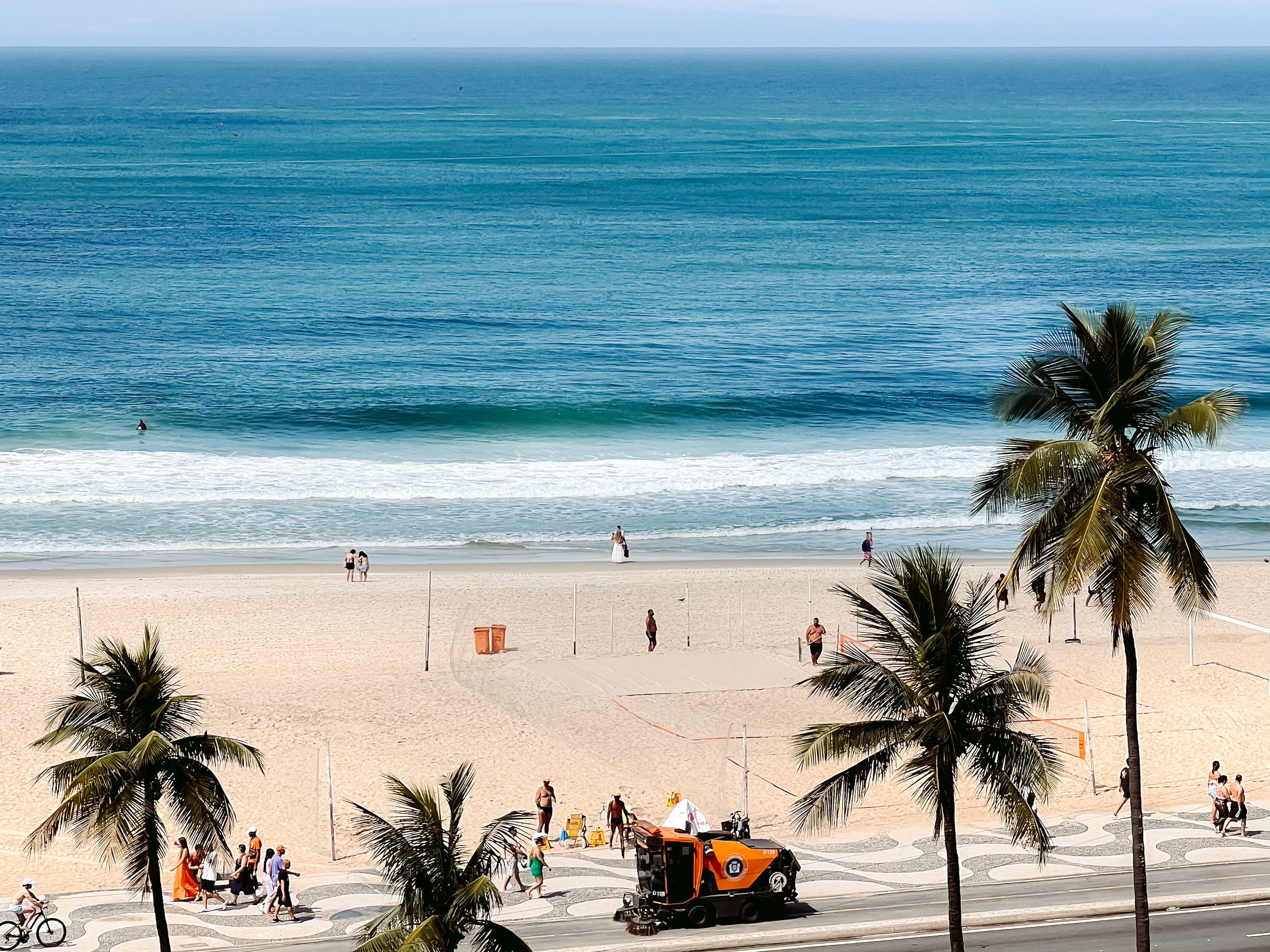
Copacabana is one of the busiest beaches in Brazil, which makes doing your part to keep it clean especially important. Take everything you bring to the beach back out with you, or dispose of your trash in the bins along the promenade. Avoid leaving behind cups, food packaging, cigarette butts, or other small items that can easily end up in the ocean.
If you buy drinks or snacks from beach vendors, hold onto the packaging until you find a bin rather than leaving it beside your chair for someone else to collect. And if you’re lucky enough to spot a sea turtle or other marine life while swimming, enjoy it from a distance without touching or chasing it.
The basic rule is simple: leave your little patch of Copacabana as clean as you found it—or cleaner.

FAQs
Is Copacabana Beach worth visiting?
I’m admittedly biased: I now live a couple of blocks from Copacabana Beach and Posto 6 remains one of my favorite places to swim in Rio. The water is generally shallower and gentler here, and the crowd tends to feel more local, especially in the morning.
Even if you don’t spend the whole day on the sand, Copacabana is worth experiencing at least once. Few places give you such an immediate glimpse into Rio’s beach culture, with swimmers, runners, footvolley players, vendors, musicians, and beachgoers all sharing the same enormous stretch of coastline.
Is Copacabana Beach family-friendly?
Yes, Copacabana is a great beach for families. There’s plenty of infrastructure nearby: you can rent chairs and umbrellas, grab coconut water and snacks from beach vendors, and find restaurants and kiosks right along the sand.
Is Copacabana Beach safe to swim in?
Yes, people swim at Copacabana year-round, but conditions vary considerably depending on the day and where you enter the water. Posto 6 is my preferred swimming spot, in part because the protected end of the beach often has gentler conditions. Every morning, you’ll see organized groups of open-water swimmers heading out from this section of Copa.
That said, pay attention to lifeguard warnings and flags, and avoid entering rough water beyond your ability.
Copacabana vs. Ipanema: Which is better?
Both—and I wouldn’t come to Rio without experiencing each at least once.
Copacabana feels bigger, busier, and more chaotic in a very Rio way. It’s the place I’d choose for a morning swim at Posto 6 or simply sitting under the sun for an hour or two.
Ipanema feels a bit more polished and social. The beaches are close enough that you don’t really need to choose. Spend a morning experiencing Copacabana, walk around Arpoador, and give Ipanema its own afternoon.
They’re two different versions of Rio’s beach culture, and both are worth knowing.


