
Americans often say they want to unplug on vacation. However, that is easier said than done. Taking a break from screen time, called a digital detox, is an intentional and disciplined act. It is all too easy for scrolling to follow us to the shoreline. So, instead of relying on self-discipline to keep that phone on do not disturb, hit a beach where you cannot connect to the internet!
A new analysis from Beach.com finds that true digital dead zones do exist on secluded, peaceful U.S. beaches. You just have to know where to look! After analyzing over 800 top-contender beaches, reviewing federal broadband and mobile coverage data, parsing over 88,000 reviews for signs of digital detox potential, evaluating commercial business density and proximity to protected lands, we built the U.S. Digital Detox Beach Index, identifying the shores where unplugging is more than aspirational, the beach demands it.
However, there are many ways to find these secret, hidden gem beaches full of tranquility. Data is one approach, but so is personal experience. Check out our guide to the U.S. beach towns for couples who hate the crowds! It’s a great first-person view of other great digital detox beach contenders!
Table of Contents
Key Findings
- Secret Beach in Curry County, Oregon, is the best beach for a digital detox in the U.S.
- Mashes Sands Beach in Wakulla County, Florida, is the second-best beach in the U.S.
- Third Beach in Jefferson County, Washington, ranks third.
The Best Kept Secret Beaches for Relaxing Digital Detox
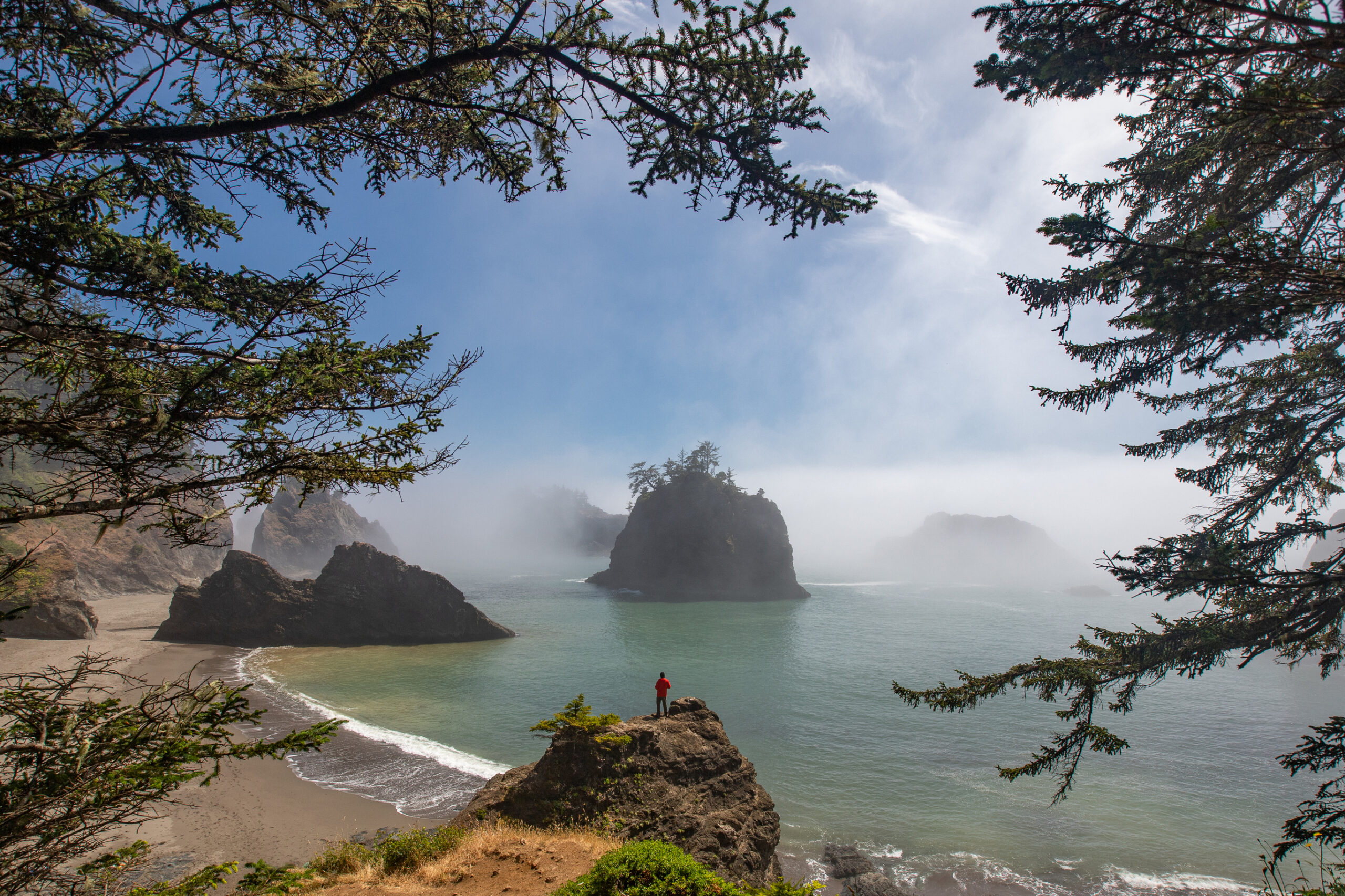
The No. 1 beach for a true digital detox tucks along Oregon’s rugged southern coast. It’s far away from boardwalk shops and beachfront bars. Secret Beach in Curry County earns the highest Digital Detox Score in the study at 9.5 out of 10. The perfect combination of digital quietness and natural isolation buoys its score.
Nearly three-fourths (74%) of the county is protected land, and mobile coverage barely reaches half (52%) of the county. Here, dropped bars are not a glitch; it’s a feature of the landscape. Commercial noise is almost nonexistent, with only 0.3 businesses per square mile. To back it up, over one in every five reviews (22%) references the exact kind of quiet and isolation that’s perfect for a digital detox beach retreat.
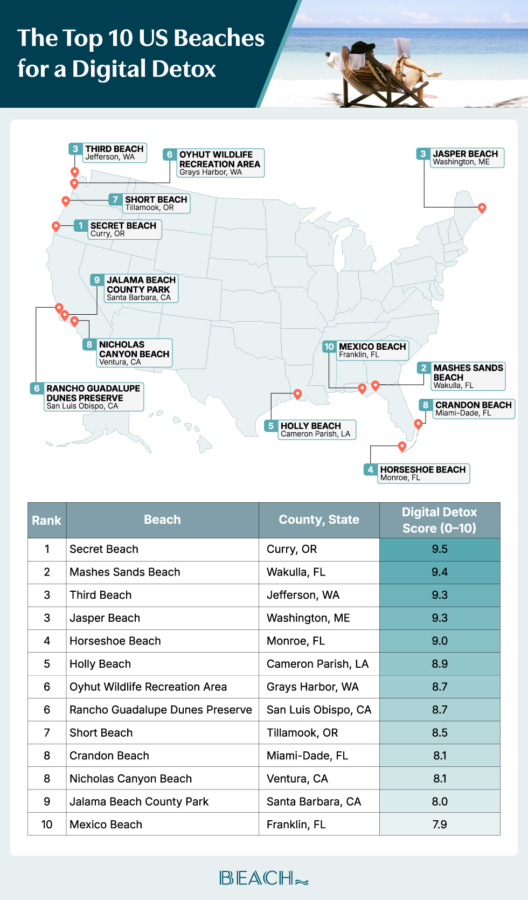
You might not picture Florida as the best state for a digital detox beach vacation. This is especially since it is a hot spring-break destination. Nevertheless, the data reveals that this state absolutely has beaches where quiet and seclusion go hand in hand. Over on the Gulf Coast, our No. 2 beach, Mashes Sands Beach in Wakulla County, earns a Digital Detox Score of 9.4.
So, why is this Florida beach perfect for a digital detox while so many others in the state are hot destinations? It doesn’t stand out for having the spottiest cell coverage or total lack of commercial businesses. Rather, it stands out for having a balance of all the factors that make a digital detox beach vacation ideal.
Nearly half (48%) of the county is protected lands, ideal for a quiet escape. There are only about 0.5 businesses per square mile. Broadband coverage is spottier and slower, the ideal excuse to unplug. Most of all, over 1 in 4 reviews (27%) include specific mentions of all things tied to peace, quiet, low crowds and relaxation. This beach is a rare find: a secluded shoreline in a state better known for its large crowds.
Rounding out the top three is a beach with a fitting name: Third Beach. It’s up in the Pacific Northwest in Jefferson County, Washington. Its Digital Detox Score of 9.3 is primarily due to its low cell coverage, a wealth of nearby protected lands and low commercial density. Barely half (58%) of the county has a signal. Over two-thirds (66%) of the county is protected land, and there are only 0.4 businesses per square mile.
Top Beaches for a Quiet Digital Detox
The top three beaches in the U.S. offer a balance of factors that lead to a good digital detox. However, our study identified many other beaches that stand out for single factors. This includes having the spottiest cell coverage, the most reviews referencing digital detox keywords, or the highest percentage of protected lands nearby.
Lowest Mobile Coverage
Up first is the beach with the spottiest cellphone coverage in our study. Pelican State Beach in Del Norte, California, has a signal in only 46% of the county. Additionally, with 59% of the county under protected land, it also stands out for its proximity to untouched nature. Topping it off, the county has only 0.3 businesses per square mile, meaning less commercial noise nearby.
Strongest Digital Detox Reviews
Next is the beach with the highest percentage of reviews that mention solitude and peace. This is first-hand accounts from beachgoers describing the qualities you hope to find at a top digital detox beach. A whopping 38% of all reviews for Crescent Beach at the southern end of Ecola State Park in Clatsop, Oregon, use digital detox-related keywords to describe this perfect escape. So, if first-hand reviews are your leading metric for finding the perfect beach for a digital detox, no other beach in our study comes close.
Least Commercialized Coastline
For near-total commercial absence on your beach retreat, you’ll find no better choice than Padre Island National Seashore in Kenedy County, Texas. With only .01 businesses per square mile (effectively rounding to zero), Kenedy County has the lowest commercial density in the study. Essentially, there is only one business per 100 square miles. This ensures that development gives way to open sand and protected coasts at Padre Island National Seashore.
Weakest Broadband Access
Another key aspect of a great coastal digital detox is low- and slow-speed broadband. On the one hand, while a poor cell signal can help you stay off your phone, it’s also important that you don’t just substitute that for a wifi connection. The best beach for staying disconnected from the internet is Holly Beach in Cameron Parish, Louisiana. Spotty broadband is generally harder to find than spotty wifi. However, Holly Beach still only has a connection in 66% of the county!
Most Protected Coastal County
We round out our standout beaches with where we began, in Curry County, Oregon. No other coastal county in our analysis has more protected land than Curry County. Nearly three-fourths (74%) of the county is protected. This guarantees you virtually universal access to pristine nature wherever you are in the county. This is especially true at the No. 1 best beach for a digital detox — Secret Beach.
Choosing a Beach That Does the Work for You
As many of us know all too well, a digital detox doesn’t happen because you promise yourself to check your phone less. At Beach.com, we know it takes serious dedication. It’s far easier to place yourself in an environment where you have no choice but to digital detox.
All of the beaches on our list share the ingredients for disconnecting. That is fewer bars, fewer businesses, slow internet, a wealth of nearby protected lands and reviews to back it all. Make the choice to digital detox easier for yourself by picking a destination where factors like this add up. And if your interests lie in a quiet, peaceful shoreline retreat outside of the States, check out our guide to this quiet Riviera Maya beach that feels like Cancún without the crowds! Happy detoxing!
Sources and Methodology
To find the best beaches in the U.S. for a digital detox experience, we began by evaluating every coastal county in the contiguous U.S. using federal datasets to identify places structurally suited for a digital detox. County-level fixed broadband (100/20 Mbps terrestrial) and 4G mobile coverage data were pulled from the FCC, protected land acreage (GAP Status 1–3) from the PAD-US database, and establishment counts from the U.S. Census Bureau to calculate business density per square mile.
After normalizing each metric, we created a Digital Detox County Score (Mobile 35%, Fixed Broadband 25%, Establishment Density 20%, Protected Land 20%), excluded landlocked counties and those without open ocean, gulf or sea coastlines, and identified the 27 highest-scoring coastal counties. Within those counties, we identified 879 beaches with at least 30 Google reviews and collected reviews containing one or more of our 335 custom keywords. In total, we analyzed 88,564 reviews with one or more of our keywords tied to low connectivity, low crowds, low commercialization and tranquility (and their opposites).
We then built a normalized Digital Detox Review Score by calculating a positive-to-negative keyword ratio for each beach and combined it with the county score (80% Review, 20% County). To reduce distortion from low review counts, we applied a capped square-root confidence curve that downweighted beaches with fewer than 200 reviews, with larger reductions at lower thresholds. The highest-scoring beach in each county was selected for the final rankings.
Click to Expand the Full Methodology
Cell and Broadband Coverage: For broadband and mobile connectivity coverage, we used “Fixed Broadband Summary by Geography Type State, County, Congressional District, Tribal Areas, CBSA (MSA)” for broadband data and “Mobile Broadband Summary by Geography Type State, County, Congressional District, Tribal Areas, CBSA (MSA)” for mobile data from the Federal Communications Commission (FCC). Both display the percentage of each US county covered for various connection types. We used the standard 100 download/20 upload for any terrestrial tech that the FCC primarily uses for coverage maps, and the standard Mobile 4G Outdoors Stationary rates that most mobile coverage maps are primarily still based on. Figures for the total county area and only residential coverage were used.
Protected Lands: To assess proximity to protected lands, we used the Protected Areas Database of the United States (PAD-US) from the U.S. Geological Survey, filtered by county through the PAD-US Statistics Dashboard. We gathered GAP Status Codes by Acres for every US county. Only GAP status codes 1-3 by acres were used for analysis. To arrive at our areas of focus, we calculated the percentage of GAP 1-3 acres per county.
Business Density: We used the U.S. Census Bureau, Statistics of U.S. Businesses, Data by Enterprise Employment Size for 2022, Counties by 3-digit NAICS table to calculate business density by county. We used the number of establishments by county to compute our density figures. To compute density, we calculated the number of establishments per sq county mile.
Digital Detox County Score: Then, we scored counties based on their Digital Detox Scores. To create these scores, we used fixed and mobile broadband coverages, establishments per sq mile and the percentage of each county under protected lands. All values were normalized before indexing. The weights we used are as follows: Mobile Coverage (35%), Fixed Broadband (25%), Establishment Density (20%) and Protected Land Percentage (20%). Scores ranged from 0 to 1, with 1 being the highest Digital Detox County Score. Then, to focus on only counties with beaches, we excluded all landlocked counties from the top X county ranks and limited our analysis to the contiguous U.S. The remaining top X county ranks were where we gathered specific beaches in our next step. Only counties bordering open ocean, gulf or sea coastlines were included. Counties with only channels, narrow or long bays, inlets, canals, straits, rivers, narrow seas and sounds were excluded.
Keyword Analysis: Next, we filtered to find the 27 counties with the best Digital Detox Score. Then we found every beach within those counties on Google Maps. Afterward, we filtered out all beaches with fewer than 30 reviews to avoid distorting the results. A total of 879 beaches were found with more than 30 reviews across the 27 counties. Then, for each beach, we gathered all reviews containing any of our 335 custom keywords related to low cell connectivity, low crowds, low commercialization, and high tranquility, as well as their opposites. Keywords were organized into two groups: those associated with a positive potential digital detox experience and those associated with a negative one. A total of 88,564 reviews containing at least one keyword were collected across the 879 beaches.
Digital Detox Review Score: Next, we created a Digital Detox Review Score to rate each beach using the keywords we gathered from reviews. To do this, we created a very simple positive-to-negative digital detox review ratio by dividing the total number of positive and negative keywords by the total number of reviews. Then we subtracted the negative rate from the positive rate, and beaches with the highest score had the best Digital Detox potential according to reviews. Scores were normalized on a scale of 0-1. We then also normalized the Digital Detox County Scores on a scale of 0-1.
Final Digital Detox Score: We combined the Digital Detox County and Review Scores into a single metric using a simple linear weighting with 20% County and 80% Review weights. Since the Digital Detox County Score was already used to identify the best counties, we did not want to overemphasize these factors a second time in the final score, which is why the county score has only a 20% weight. To also avoid noise from beaches with very low review counts, we induced a capped nonlinear confidence weighting curve. This curve allowed us to logarithmically scale weights to the total number of reviews using a basic square-root curve. Meaning, beaches with a very small number of reviews received heavier downweighting than those with more reviews, with the downweighting capping at the 200-review threshold. For example, a beach with 30 reviews received more downweighting than a beach with 80 reviews. After 200 reviews, a beach received no downweighting. To compile our top beaches, we selected the best beach in each county with the highest digital detox score.
Fair Use
When using this data and research, please attribute by linking to this study and citing Beach.com.